Amazon Echo Dot (5th Gen) Review: Is It Worth £55?

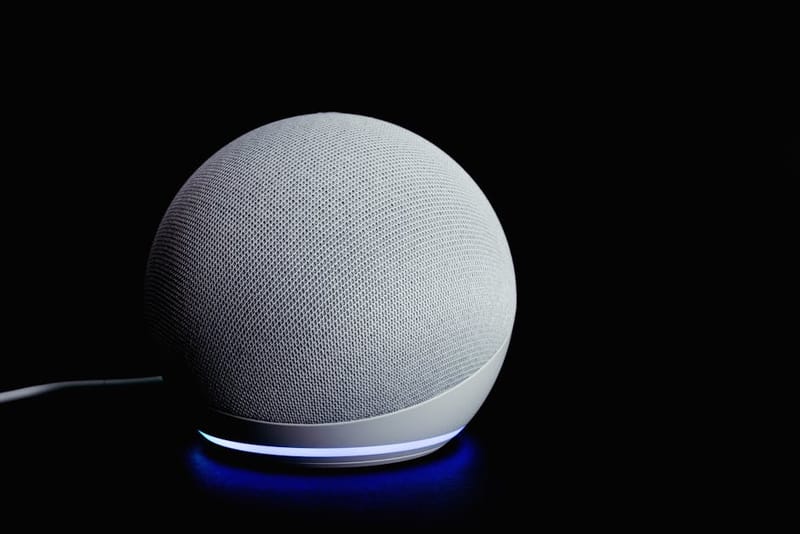
The Echo Dot is the product that decides whether someone gets into smart homes at all. At £54.99 RRP and routinely £29-39 on Prime Day, it's the cheapest mainstream smart speaker in the UK, and as Amazon's own hardware it tends to be the loss-leader the entire Alexa ecosystem is anchored on. The 5th-generation Dot is the third revision of that puck-shape since 2018, and the question for most buyers isn't whether the Dot is good - at this price, it's good enough - but whether it's worth upgrading from a 3rd or 4th-gen Dot, and whether the Echo Pop is the smarter buy now that it exists.
What's in the box and what it costs
The 5th-gen Dot ships in a small recycled-card box with the spherical speaker, a 15W mains power adapter (no battery - the Dot lives on the wall), a quick-start leaflet, and nothing else. Setup is the standard Alexa flow: plug in, open the Alexa app on a phone you've already signed into your Amazon account on, and the app finds the Dot over Bluetooth, hands it your Wi-Fi credentials, and pairs in under three minutes. There's no Ethernet option, no display, and no separate hub - Wi-Fi to the Dot, voice to Alexa, that's the whole stack.
Pricing in the UK runs £54.99 for the standard Dot, £64.99 for the Echo Dot with Clock variant which adds an LED display on the front showing time and basic information. Both drop to roughly £29-39 during major Amazon sales - Prime Day in July, Black Friday in late November, the January sales, and occasionally one-day deals throughout the year. The honest advice is to wait for one of those windows: full RRP rarely makes sense for a product that goes on sale this often.
How it sounds (the upgrade most owners actually feel)
The single most-reported difference between the 5th-gen Dot and the 4th-gen it replaces is sound quality, and based on aggregated reviews and Amazon's own published specs, that difference is real. The 5th-gen has a 1.73-inch front-firing speaker (up from the 4th-gen's 1.6-inch) and noticeably better mid-range clarity. Voice prompts and podcasts come through cleaner. Bass is still limited by physics - there's only so much a sub-100mm sphere can do - but the muddy low-mid that made the 4th-gen unpleasant on music-heavy podcasts is gone.
For voice and podcasts, the 5th-gen Dot is genuinely listenable in a kitchen or small bedroom. For music, it's fine for background but won't replace a real speaker. Two Dots paired in stereo improves the sound stage but doesn't add bass - at that point a single £79 standard Echo or a budget bookshelf speaker via Bluetooth makes more sense. The Dot is a voice speaker first, a music speaker as a bonus.
What's actually new in the 5th gen
Three things genuinely matter beyond the speaker upgrade.
Temperature sensor. The Dot now has a built-in temperature sensor accessible to Alexa routines. "When the bedroom temperature is above 24°C, turn on the smart fan" is a routine you can build without buying a separate sensor. It's a small thing, but it's the kind of feature that quietly justifies buying the new Dot rather than the 4th-gen at clearance prices.
eero Wi-Fi mesh extender. If you already have an eero router (Amazon's own mesh Wi-Fi system), the Dot doubles as a free Wi-Fi mesh node. This is the feature most under-mentioned in reviews because most UK households don't have eero, but for those who do, it's a meaningful saving - eero mesh nodes start at £80.
Matter and Thread support. The Dot is now a Matter controller and (per Amazon's roadmap) a Thread border router. That matters less today than it will in two years: as more smart-home devices ship Matter-native, the Dot becomes the entry point for an interoperable smart home. Not a reason to buy now, but a reason not to be worried about future-proofing.
Where the Dot falls short
Three real limitations to plan around.
The 3.5mm audio output is gone. Earlier Dot generations had one, letting you hook the Dot to existing wired speakers. The 5th-gen removed it. If you wanted the Dot as a £55 way to add Alexa to a bookshelf hi-fi, that path is closed - you'd need to use Bluetooth, which works but adds latency and pairing fragility.
The mono speaker is genuinely limiting. Two Dots paired in stereo sounds better but costs £110 and still doesn't beat a single full-size Echo at £79. If you actually care about music, skip the Dot.
The privacy footprint is real. Always-listening mics, Amazon account integration, voice recordings stored by default. There's a hardware mute button, voice recordings can be set to auto-delete, and Alexa's request-handling has tightened over the years - but the trust ask is non-trivial. If you're not already deep in the Amazon ecosystem and uncomfortable with that posture, the Dot probably isn't for you.
Echo Dot vs Echo Pop vs full Echo: which Alexa speaker fits
Amazon now sells three voice-only Alexa speakers in the UK, and the differences matter at these price points.
Echo Pop (£44.99 RRP, £19-25 on sale) is the budget option. Smaller speaker, no temperature sensor, no eero mesh, no Matter controller. Buy it if you want Alexa for voice prompts only - alarms, timers, weather, lights - and don't care about audio quality.
Echo Dot (£54.99 RRP, £29-39 on sale) is the default. Better speaker than the Pop, the smart-home features (temperature, Matter, eero) are real, and on sale it's barely more expensive than the Pop. For most people this is the right buy.
Echo (£79.99 RRP, £49-59 on sale) is the upgrade for anyone who'll actually listen to music on the speaker. Bigger driver, real bass, stereo-quality on a single unit. The premium over the Dot is small enough that it's worth it for a kitchen or living-room speaker.
Specifications
- Speaker
- 1.73-inch front-firing
- Wireless
- Wi-Fi 5, Bluetooth 5.0
- Smart-home protocols
- Matter, eero mesh, Sidewalk
- Sensors
- Temperature, motion (Tap to Alexa)
- Dimensions
- 100 × 100 × 89 mm, 304g
- Typical UK price
- £54.99 RRP, £29-39 in major sales
- Warranty
- 1 year (Amazon UK)
Frequently asked questions
Is the 5th-gen Echo Dot worth upgrading from a 4th-gen?
Echo Dot or Echo Pop - which should I buy?
Can I use the Echo Dot without an Amazon account?
Does the Echo Dot work with Google Home or Apple HomeKit?
How private is the Echo Dot?
Buy on a sale, not at RRP
The Dot is regularly £29-39 during Prime Day, Black Friday, and the January sales. Full RRP rarely makes sense for a product that discounts this often.